


Preschool Program

Pathway Montessori's child care program uses the Montessori methodology "to inspire a love of learning". The Montessori Method recognizes the uniqueness of each child and allows the child to develop according to her/his own inherent abilities and timetable. Even children with disabilities do very well in a Montessori environment. Our curriculum includes exposing the children to Maria Montessori's five developmental areas-practical life, sensorial, math, language and cultural. In a carefully-prepared environment, a variety of authentic, Montessori materials are arranged to appeal to their love of logic and order and their own natural desire to learn. The many activities utilize unique materials that strengthen fine motor control, lengthen concentration and sharpen the senses. Children are allowed the freedom to practice and refine their skills and cultivate good work habits. They are guided through various lessons and have to opportunity to explore their own unique interests and talents.

The classrooms consist of a mixed age groups where the younger children learn from the older children and the older children reinforce their learning and leadership skills. There is plenty of opportunity for socialization as that children worth both independently and as a group. The classroom provides a rich environment containing cards and activities they use to explore language and there are regular store times. Our school offers well-equipped classrooms, with qualified preschool teachers and each classroom is lead by at least on qualified, Montessori directress who interacts with the children in a living manner. Most of our Preschool programs include a French language lesson, music lessons, arts and crafts and a library corner to promote time for individual reading. Pathway's success stems from happy children, happy teachers and satisfied parents.

ECS Kindergarten

Being an Alberta Learning accredited program, our kindergarten is overseen by a certified Alberta Education teacher and is part of our Calgary school curriculum only. For half of each day, this teacher ensures that all of the Alberta Learning curriculum goals are being met. This teacher works in partnership with our Montessori-trained teacher to provide a stimulating and satisfying program for our students.

The full-day Early Childhood Services Kindergarten program provides an excellent foundation with which children may enter grade school. In accordance with the Montessori Philosophy, strong emphasis is placed upon the development of literacy and numeracy. Both language arts and mathematical skills are taught in a progressive, systematic manner. As a result of learning through a strong program of phonics, the students will know their letter sounds and many phonograms by year end. Many students leave our program already reading and spelling. Their printing skills demonstrate their well-developed focus, concentration and attention to detail. Through the year, focus is also given to learning the geography of our world. The students become aware of their place on our planet by learning the continents, countries and provinces. In addition to these curricular areas, our students participate in music and French classes. We also take the children on field trips as well as host special guests. These are opportunities where the students are their families celebrate their place in our school community.

For our ECS Kindergarten Program to be funded by Alberta Education, we had to have a Non Profit Society to represent us. With the help of the Kindergarten parents and dedicated staff, both volunteering their time, the school established its own Woodpark Montessori Society in 2008 to operate and finance the Kindergarten program.

Philosophy

Dr. Montessori believed that no human being is educated by another person; he must do it himself or it will never be done. She therefore felt that the goal of the educational process should not be to fill the child with facts but rather to cultivate his own natural desire to learn and to help him express his creative soul as early in life as possible. Her search revealed  that children are most eager  to learn between the ages of two and six, the period when a child can pick up knowledge and understanding of his environment life a sponge and consider it a natural and delightful activity. She also discovered that during these early years there are sensitive age periods when the child shows unusual ability to acquire particular skills and when it is actually easier for him to learn those skills than to any other time in his life.

She found that small children possess a deep-seated love of logic and order in the arrangement of things around them and will work best within a carefully prepared environment that gives order and logic to the impressions they receive. The classroom environment that she prepared was scaled to a child’s size and geared to her inner needs. It allowed him to experience the excitement of learning by his own choice and at this own speed.  She believed that children are best able to comprehend their environment in very concrete ways, through immediate personal contact, and so she designed concrete tools to lead the child forward towards the ability to work in abstractions- the numbers, letters, and ideas which older people use to represent concrete things. When a child does begin these activities he learns them in the same natural way he learns to walk and talk.

She felt that the teacher should serve as an enthusiastic guide in the child's progress from simple to complex, from using rudimentary to refined tools and from out to self-control. They should not be the source of all their knowledge and discipline. She saw that, from her own personal experience, the child learns best from other children. Therefore, her children were grouped together in order to give the younger ones a graded series of models from imitation and the older ones an opportunity to reinforce their own knowledge by helping those younger. Her research also indicated that children have fantastic powers of concentration if properly stimulated, far exceeding that of most adults.

When you observe the Montessori class in action, you understand the secret of her success. The habits, skills and approach to learning which a child develops in a Montessori class can be good for a lifetime. They will help him/her to work more effectively, to observe more carefully, to concentrate more effectively, to learn more joyfully, and thus to realize their own best potential all through life life. They have the tools to continue their self-education - the only real education - no matter where they go.

5 Areas of the Class

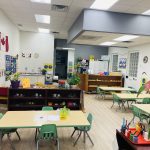
Maria Montessori found that next to learning from their own experience, the child learns best from other children. Therefore she created a mixed age group where the younger children imitate older and older children reinforce leadership skills by sharing their knowledge with the younger children. Each classroom is scaled down to a child's size and provides an enriching and stimulating environment.

Each classroom is comprised of the following five areas of learning:

1.)Practical Life

These activities comprise of care of the person, caring for the environment and lessons in grace and courtesy.  These exercises include activities such as pouring, sorting, sewing buttons, carrot peeling, serving, mirror polishing and many other activities using real life objects in a child sized environment.  These activities encourage good work habits, increase concentration, independence, and develop coordination.  The Practical life activities prepare the child for all other subject areas of the classroom. 

2.)Sensorial

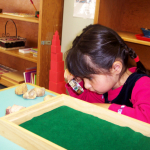
It is through the five senses that the sensorial materials prepare the child to sharpen their abilities in learning reading, writing and mathematics.  For example the child who has perceived the subtle differences of sounds in the sound cylinders will be more likely to perceive subtle differences in the phonetic sounds of letters.  The grasping of small knobs on equipment enables a child to gain control over the small finger muscles he will use for writing.   Using the senses to explore the diverse materials designed using variable dimension, color, shape, texture and smell, develops all faculties of intelligence.

3.)Language

Language is explored phonetically in a Montessori classroom.  Initial alphabet sounds are first introduced through the sandpaper letters and matching objects.  After the children learn a few sounds, they are then introduced to blending exercises with the moveable alphabet.  The metal insets are an exercise used to refine pencil control and help to improve writing skills.

4.)Mathematics

We use hands on materials to provide the child with a simple and clear understanding of the mathematical concepts being taught; examples are: number rods, sandpaper numbers, number boards, number beads, tiles and games.  Each exercise builds upon another gradually guiding the child’s mathematical mind from the concrete into the more abstract areas of numeration.

5.)Cultural

The cultural area is divided into geography, history, nature and science.  There are many geography materials in the classroom to teach a child their place in the world.   History assists a child in learning about the concept of change.  By looking at the seasons, studying the weather and changing the calendar daily it helps the child to establish a cycle of time.  Children are encouraged to bring things to put in our nature area.  When a child’s birthday arrives there is a special lesson that occurs:  a representation of the sun is placed on the floor and the birthday child holds the globe and walks around.